

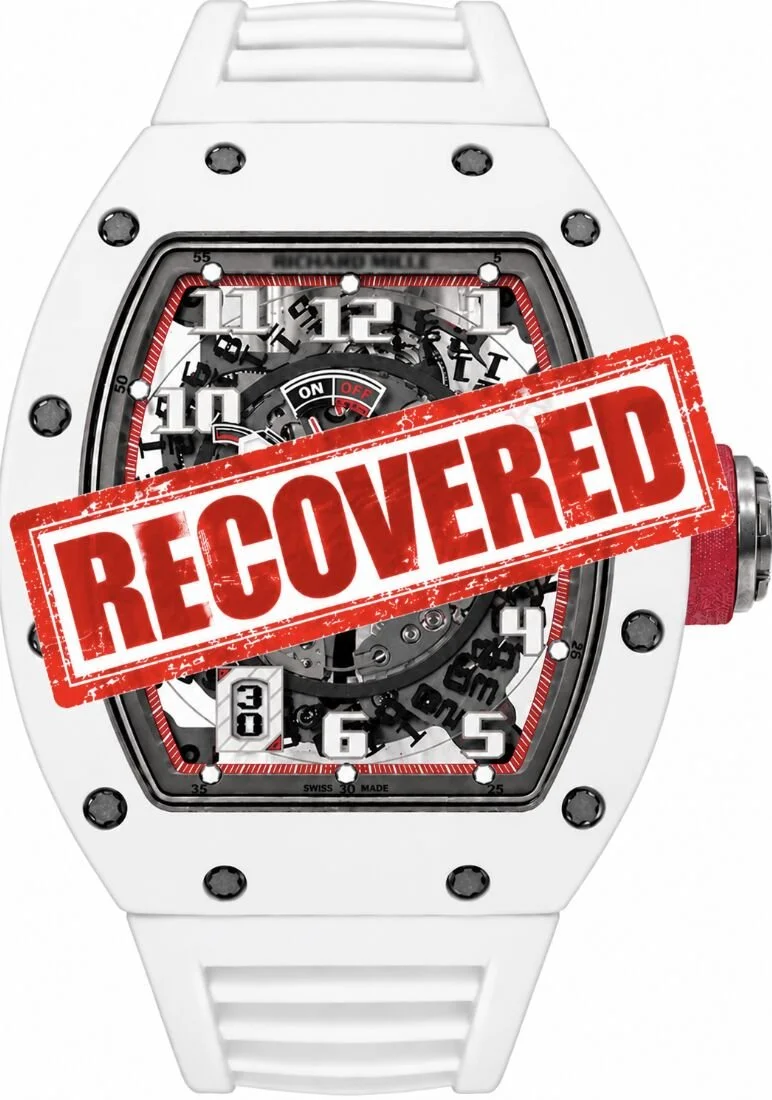
Richard Mille RM 030 Limited Edition “White Rush”
RM 030 Limited Edition “White Rush”
$250,000 STOLEN WATCH RECOVERED — THANKS TO AN INSTAGRAM “FLEX”
Ten years after it was violently stolen in Paris, a $250,000 watch has finally been recovered. And a social media post helped us find it. In 2016, the owner was sitting in his car in Parisian traffic when a gang of thieves approached on scooters, attacked him and stole his watch. The perpetrators were arrested, but the watch was nowhere to be found.
Until last month.
The watch resurfaced when an unsuspecting celebrity buyer began “flexing” his new acquisition on Instagram. Fortunately for us, his videos were detailed enough to reveal the serial number on the reverse.
Art Recovery International (“ARI”) and its affiliate, Watch Recovery International, positively identified the watch as the one stolen in Paris nearly a decade earlier. ARI’s counsel, Christopher A. Marinello, then negotiated the unconditional and confidential surrender of the stolen timepiece with the attorney representing the innocent buyer. Fortunately, the buyer was also able to recover his purchase price from the New York watch dealer who had sold him the stolen watch.
Unfortunately, an increasingly common practice among watch dealers and online auction houses is to block or obscure serial numbers on watches offered for sale. When challenged, dealers claim this is necessary to prevent Chinese counterfeiting or potential insurance fraud.
I don’t buy it.
Whatever justification is offered, concealing serial numbers makes it much more difficult for victims and organisations like ours to identify stolen watches openly circulating in the marketplace. Serial numbers exist for a reason. Hiding them protects the illicit trade, not the consumer. Transparency helps legitimate buyers. It helps theft victims. And it helps keep stolen watches out of the marketplace.
Dealers and auction houses may occasionally succeed in obscuring the history of a stolen timepiece, but the serial number doesn’t disappear. Eventually, many of these watches are brought to the manufacturer for servicing, authentication or archival research. That is when the serial number may be checked against the manufacturer’s stolen-watch records—and the problem suddenly resurfaces. And when we are brought in to recover the stolen watch, guess who we will be looking to for reimbursement of the innocent buyer?
The very same dealer or online auction house that concealed the serial number in the first place.
Once again, we are involved in a high-value watch recovery where the original theft victim was not insured for the loss. I hope some of our insurance-company partners take note and develop products specifically for Middle East-based collectors who are accustomed to the relative security of their possessions at home. The moment they travel to the “Wild West” wearing a high-value watch, the risk can change dramatically.